Quick tour summary for trip planning
Badlands National Park earned International Dark Sky Park certification from DarkSky International on July 17, 2026. It is the first and only certified International Dark Sky Park in South Dakota, one of roughly 40 National Park Service units to hold the designation, and one of just two in the Park Service’s Midwest Region.
This is a private evening tour from Rapid City built specifically around that certification. We leave in the late afternoon, work through the park while the light is still doing something interesting, then move to a dark viewing spot and stay put. The certification is the whole point of the trip rather than a footnote at the end of it.
This tour is arranged by request rather than through an online calendar, because the nights worth booking depend on moon phase and forecast. Tell us your travel dates and we will point you at the best ones in your range.
We also run this experience under our Badlands-focused brand, Badlands Tour Company. Both are operated by My XO Adventures LLC out of the same office in Rapid City, with the same guides and the same vehicles.
Badlands National Park Is South Dakota's First International Dark Sky Park
The International Dark Sky Places Program has been run by DarkSky International since 2001. It is not a scenic award and it is not something a park applies for and receives. A park has to prove it, with measured sky-quality readings taken over time, a full inventory of every outdoor light fixture on the property, a retrofit plan that brings that lighting into compliance, ongoing monitoring, and a public education commitment that continues after certification.
Badlands National Park started that work in 2018 after visitors and conservation partners pushed for it. It took roughly seven years. Park staff and the Badlands National Park Conservancy replaced outdoor lighting across park facilities to cut glare and skyglow, and set up long-term night sky monitoring. The certification arrived at an evening ceremony on July 17, 2026.
What the certification actually tells you: the Badlands sits at roughly Bortle Class 2 on a nine-point scale of night sky darkness, where Class 1 is the darkest sky measurable on Earth and Class 9 is an inner city. At Class 2, the Badlands National Park Conservancy reports more than 7,500 stars are visible to the naked eye on a clear night. For comparison, a typical suburban backyard shows a few hundred.
That darkness is not only a view. The park supports nocturnal species that need real darkness to function, including burrowing owls, several bat species, and the endangered black-footed ferret, one of the rarest mammals in North America. Protecting the sky and protecting the ferret turned out to be the same project.
What kind of experience is this?
Slow. That is the honest one-word answer.
Most Badlands itineraries treat the park as a drive-through with a photo stop every fifteen minutes. That does not work after dark. Your eyes need somewhere between twenty and thirty minutes of uninterrupted darkness to fully dark-adapt, and every glance at a phone screen resets the clock. So the structure of this tour is deliberately front-loaded: we do the moving early, and once we reach the viewing site we stop moving.
You get zero-gravity recliners rather than standing around. You get a guide who can actually navigate the sky rather than a guide reading an app out loud. And you get a location chosen for the specific night, based on moon phase, cloud forecast, and where the Milky Way core will sit relative to the formations.
Tour Snapshot
- Departs from: your Rapid City lodging (hotel, motel, or vacation rental)
- Destination: Badlands National Park, International Dark Sky Park
- Duration: approximately 7 hours
- Timing: late afternoon departure, late night return
- Group type: private, your party only
- Pricing: $995 total for two guests plus taxes and fees, $350 per additional guest, two guest minimum
- Season: best March through October, available year-round by request
- Park entry: included
- Booking: by request — contact us for available dates
This tour is a good fit if...
- You want to see the Badlands the way the certification describes it, not just drive through it
- You are willing to be out late. Real astronomical darkness in summer does not begin until well after 10:00 PM
- You would rather sit in one excellent place for ninety minutes than see six places for ten minutes
- You are traveling as a couple, a family with older kids, or a small group and want the vehicle to yourselves
- You want to photograph the Milky Way and would like help with the settings rather than a lecture
- You have never seen a genuinely dark sky and want the first time to be a good one
This tour isn't a good fit if...
- You need to be back at your hotel before 10:00 PM
- You are traveling with very young children who will not stay awake or seated after dark
- You want a large-group bus experience at a lower per-person price
- You are looking primarily for wildlife. Our Badlands Sunset Flight and Night Sky Wildlife Tour is the better match
- You want the sunset to be the main event rather than the opening act. In that case take the Badlands Sunset and Night Sky Tour instead
How the Evening Flows
Late afternoon, pickup in Rapid City. We collect you from your lodging in a climate-controlled vehicle. The drive east gives us time to cover what the certification means and what to expect from the sky that specific night.
Golden hour, into the park. We enter Badlands National Park with light still on the formations. This is when the Wall reads best: long shadows, warm color, and the banding in the rock at maximum contrast. Stops depend on the light and the crowds, not a fixed list.
Sunset, position rather than chase. Most park traffic is heading out at exactly this point. We are heading in. We pick a viewpoint and let the color do its thing rather than driving through it.
Blue hour, the transition. The half hour after sunset is when the landscape goes cool and the first planets appear. It is also when we set up: chairs out, red lights on, white light off.
Astronomical twilight ends, dark adaptation. Roughly ninety minutes after sunset the sky reaches full darkness. Your night vision comes up over the following twenty to thirty minutes, and the star count climbs with it. This is the part people are unprepared for. The sky keeps getting deeper the longer you stay.
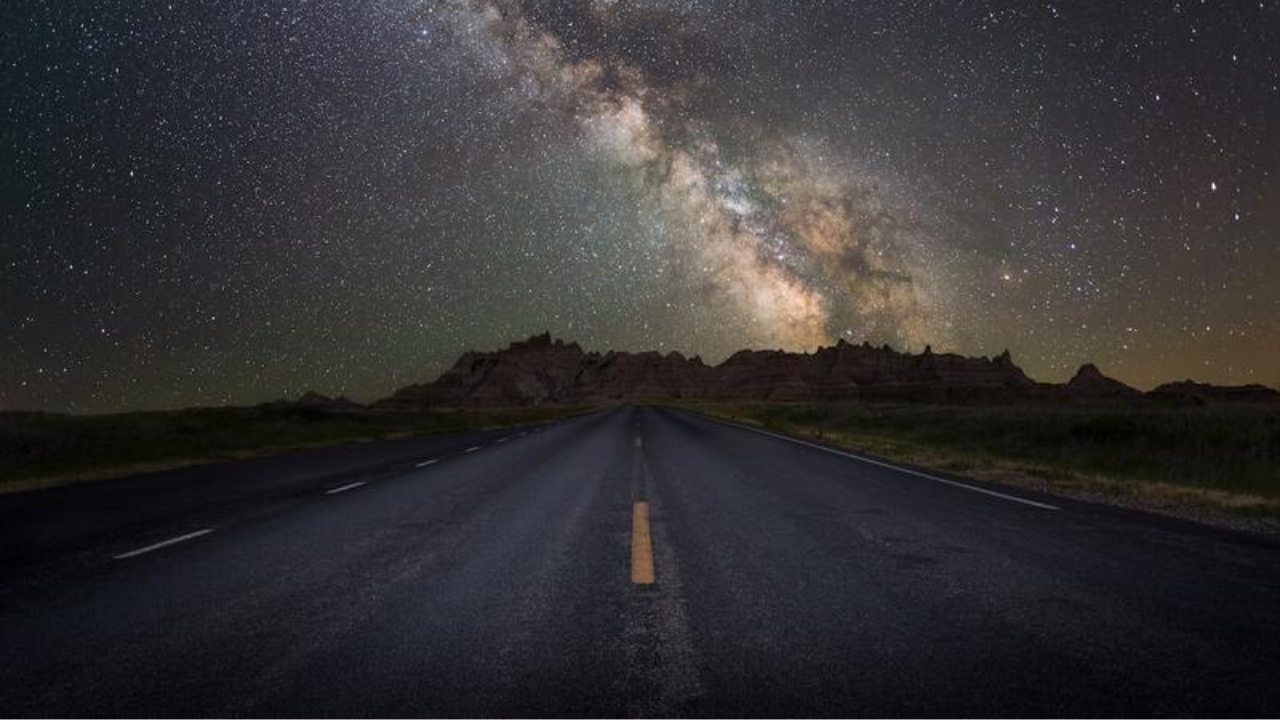
Full dark, the main event. Constellation work, planets, star clusters, and from roughly April through September, the Milky Way core rising over the formations. Telescope time when conditions allow. Photography help for anyone who wants it.
Return to Rapid City. Quiet drive back. Most guests sleep.
Where We Watch the Sky Inside the Park
There is no single best dark sky spot in the Badlands, which is the advantage of running this privately. The right location depends on moon phase, wind, cloud direction, and where the Milky Way core will sit. Areas we work with:
- Sage Creek Rim Road and the Sage Creek Wilderness Area — the darkest and most remote section of the park, gravel access, and the lowest horizon glow in any direction
- Hay Butte Overlook — wide-open western prairie views with formations framing the southern sky
- Pinnacles Overlook — elevation and a long sightline down the Badlands Wall
- Bigfoot Pass Overlook — sheltered from wind, formations close enough to sit in the frame
- Big Badlands Overlook — the classic Wall panorama, strongest early in the evening
If you want the daytime version of these locations, we cover them in our guide to the best viewpoints in Badlands National Park.
What You Can Actually See in a Bortle 2 Sky
Setting expectations honestly, because dark sky photography online sets them badly.
What your eyes see: the Milky Way as a genuine structured band with visible dust lanes, not a faint smudge. Andromeda as a naked-eye object. Individual star colors. Satellites crossing constantly. Meteors most nights without a shower. Airglow near the horizon. Enough starlight to walk by without a flashlight.
What your eyes do not see: color in nebulae. That is a camera effect from long exposure, not an eye effect. Anyone who tells you otherwise is selling something.
What the camera sees: the version you have seen online, with color, structure, and depth, achievable with a 15 to 25 second exposure at a wide aperture. Recent phones do a credible job in night mode if you can brace them.
By season:
- Spring (March to May) — Milky Way core rises before dawn, excellent early-season transparency
- Summer (June to August) — core high and bright by mid-evening, warmest conditions, latest darkness
- Fall (September to October) — core sets in the evening, crisp air, earliest full darkness of the warm season
- Winter (November to February) — Orion, the winter Milky Way, and the sharpest transparency of the year. Cold but exceptional
Aurora is an occasional bonus rather than a promise. When conditions line up, South Dakota does get displays. See our notes on the northern lights in South Dakota.
Lakota Star Knowledge and the Badlands Night
The Badlands sit within the traditional territory of the Oceti Sakowin, and this sky was read as a map and a calendar long before it was measured on a Bortle scale. Lakota star knowledge ties specific constellations to specific places on the ground and to the seasonal round of travel between them, the sky and the landscape describing each other.
We share what has been shared publicly and appropriately, and we are clear about the line between what is ours to tell and what is not. If that context matters to you, our land acknowledgment and our writing on the importance of Lakota heritage go further.
Night Sky Photography on This Tour
You do not need a camera. If you brought one, you will get help with it.
- Bring a tripod if you own one. It is the single biggest difference-maker, well ahead of the camera body
- Fast wide lens if you have one — 14mm to 24mm at f/2.8 or faster is ideal, but a kit lens at f/3.5 still produces a usable Milky Way frame in a Bortle 2 sky
- Starting point: ISO 3200, widest aperture, 15 to 20 seconds, manual focus set on a bright star using live view zoom
- Phones: night mode plus something solid to rest on. A small flexible tripod is worth the twelve dollars
- Red light only once we are set up. One white phone screen costs everybody twenty minutes
For daytime and golden hour photography in the park, see our Badlands photography tours writeup.
What's Included
- Private guide with night sky experience, your party only, no strangers added
- Round-trip pickup and drop-off at Rapid City lodging
- Badlands National Park entrance fee
- Climate-controlled vehicle
- Zero-gravity reclining chairs for comfortable sky viewing
- Telescope and binoculars, conditions permitting
- Red-light headlamps to protect night vision
- Star charts and green laser pointer for constellation work
- Night sky photography guidance
- Bottled water and light snacks
What's Not Included
- Tipping is part of how your guide is paid, so if they gave you a good day, a tip is expected rather than a bonus
- Dinner. We recommend eating before pickup. See places to eat near Badlands National Park
- Camera equipment
- Alcohol
Best Time to Book a Badlands Dark Sky Tour
Moon phase matters more than season. A full moon washes out the Milky Way completely no matter how dark the park is certified to be. The ten-day window centered on the new moon is the target. If your travel dates are flexible at all, tell us and we will point you at the best nights in your range.
Book early for new-moon dates in June, July, and August. Those fill first, and the certification announcement has increased demand noticeably.
Weather policy: if the forecast is genuinely unworkable we contact you ahead of time rather than driving you out for nothing, and you choose: reschedule, or switch to a different Badlands experience. Your tour operates either way.
For broader trip timing, see our guide to the best times to visit the Black Hills and Badlands.
What to Bring
- Layers, and more than you think. The Badlands is high prairie. A 90 degree afternoon can become a 50 degree night, and there is usually wind
- Closed-toe shoes with real soles
- A warm hat. You lose heat fastest from your head while sitting still
- A blanket if you get cold easily
- Your phone in night mode or on a red filter
- Curiosity, and a willingness to be out past your bedtime
More general preparation is in our Badlands travel tips.
FAQ: Badlands International Dark Sky Park Tour
When did Badlands National Park become an International Dark Sky Park?
Badlands National Park was certified as an International Dark Sky Park by DarkSky International on July 17, 2026, at an evening ceremony in the park. It is the first and only certified International Dark Sky Park in South Dakota, and one of roughly 40 National Park Service units nationwide to hold the designation.
How many stars can you see in Badlands National Park?
More than 7,500 stars are visible to the naked eye on a clear night, according to the Badlands National Park Conservancy. The park measures at roughly Bortle Class 2, the second-darkest category on a nine-point scale, compared with a few hundred visible stars in a typical suburban sky.
What time does the Badlands dark sky tour start and end?
Pickup is in the late afternoon and the tour runs approximately seven hours. Exact times shift by season because they are set by sunset, not by the clock. In June, full darkness does not arrive until after 10:30 PM, so the tour runs late. In October, the same experience finishes considerably earlier.
Do I need to know anything about astronomy?
No. Most guests arrive knowing the Big Dipper and nothing else, which is a fine starting point. Your guide handles orientation and answers questions at whatever level you want.
Can I bring children on the dark sky tour?
Older children who can stay awake and seated after dark generally love it. Very young children usually find the late timing and the sitting still difficult. Because the tour is private, you are not affecting anyone else’s evening either way.
What happens if it is cloudy?
Clouds can make sunset richer and more colorful, even if star visibility is reduced. If the forecast makes us think clouds are likely to hide the stars, we’ll reach out ahead of time and change your tour to the earlier Badlands Sunset and Golden Hour Tour, unless you’d rather keep your Dark Sky Park tour and give it a shot. Whether to make that change is our call. The change isn’t a rescheduling and carries no rescheduling fee, and clouds aren’t a reason for a refund. Either way, your tour operates.
Is the Badlands dark sky tour cold?
It can be, in any season. The prairie loses heat quickly after sunset and there is almost always wind. Layers solve it. We would rather you overpack than spend the best hour of the night shivering.
How do I book the Badlands International Dark Sky Park tour?
This tour is arranged by request rather than through an online calendar, because the nights worth booking depend on moon phase and weather. Contact us with your travel dates and we will tell you which nights in your range are best, then hold one for you.
Official Dark Sky Resources
Who is taking you
Your guide will be one of the named, certified guides on our Meet Your Guides page, and if you want to know which one leads your date, ask us before you book and we will answer with a name.
Availability and Booking
Book Your Dark Sky Date
Pricing is $995 total for two guests plus taxes and fees, $350 per additional guest, with a two guest minimum. There is no online calendar for this tour on purpose: the nights worth booking depend on moon phase and forecast, so we match you to the best dates in your travel window rather than letting you pick blind. If the Badlands is the only park on your list, our own Badlands Tour Company runs a Badlands-only stargazing tour from Rapid City.
Traveling with a larger group, or want this combined with a daytime Black Hills itinerary? Start with our personalized Black Hills tours page or contact us directly.
Keep Exploring the Badlands After Dark

 ★★★★★3 months ago
 ★★★★★3 months ago
 ★★★★★a month ago
 ★★★★★5 months ago
 ★★★★★2 months ago