
Daniel Milks
I absolutely love travel, experiences, am a bit of a daredevil, and an occasional writer. My favorite place is the place I've never been.
Why was Mount Rushmore built?
South Dakota historian Doane Robinson wanted a tourist attraction that would draw visitors to the state and boost its economy, so in the early 20th century he had the idea to carve famous American figures into the granite of the Black Hills.
When you think of Mount Rushmore, what is the first thing that comes to mind? Many people associate this national memorial with patriotism and American pride. But do you know why it was actually built in the first place? It wasn’t just for its majestic appearance or grandeur – the powerful story behind it speaks volumes about our country’s history.
In this blog post, we will explore why Mount Rushmore exists today and discover the political and social motivations that led to its creation over 80 years ago. Then, let’s dive into the exciting tale behind America’s most recognized stone sculpture!
Where’s Mount Rushmore?
Nestled in the Black Hills of South Dakota, Mount Rushmore towers above the landscape, commanding attention and awe from all who look at it. This iconic monument symbolizes American ingenuity and perseverance, as the faces of four of our nation’s most prominent leaders – George Washington, Thomas Jefferson, Theodore Roosevelt, and Abraham Lincoln are etched into the mountainside for all to see.
Our private Mount Rushmore tour from Rapid City takes you there.
Historical Background of Mount Rushmore and Its Significance
Have you ever wondered what lies beyond the faces of some of America’s greatest presidents carved into Mount Rushmore? While most people have been mesmerized by this famous mountain sculpture, few have taken the time to learn about its history and recognize why it is meaningful. From understanding the initial conception of Mount Rushmore to watching years of hard work result in an art form marveled at around the world, it truly encompasses a piece of American History worth exploring.
Here, we seek to uncover what could be considered one of America’s hidden gems and understand why recognizing its importance has stood the test of time amongst many Americans today.
A Look at Mount Rushmore Through a Lakota Perspective
Mount Rushmore, a colossal carving of four American presidents on a South Dakota mountain, is considered a national treasure by many. However, it is a controversial reminder of a painful past for the Lakota people, who call the surrounding land home. The mountain is considered sacred and known as “The Six Grandfathers.” The Lakota see it as an extension of the Black Hills, which were taken from them in violation of their treaty rights.
For them, Mount Rushmore represents the theft of their land and culture and the loss of their sacred sites. However, the Lakota are not against preserving history but believe in telling the whole story, including the harm done to their people. It is a complicated and emotional subject that demonstrates the power of history and the need to consider all perspectives.
For them, Mount Rushmore represents the theft of their land and culture and the loss of their sacred sites. However, the Lakota are not against preserving history but believe in telling the whole story, including the harm done to their people. It is a complicated and emotional subject that demonstrates the power of history and the need to consider all perspectives.
Mount Rushmore may be celebrated as one of the most iconic landmarks in the United States. Still, its construction is a painful reminder to the Native Americans who call the Black Hills of South Dakota their ancestral home. The faces of George Washington, Thomas Jefferson, Theodore Roosevelt, and Abraham Lincoln were carved into a sacred mountain for the Lakota Sioux people.
This act of colonization symbolized the United States government’s aggression towards Indigenous populations, who were forcibly removed from their lands to make way for white settlers. Despite ongoing efforts to reclaim the Black Hills and protect the land from further exploitation, the legacy of Mount Rushmore continues to be a source of controversy and pain for Native Americans.
The Truth Behind Mount Rushmore’s Inspiration
Mount Rushmore is one of the most iconic landmarks in the United States, attracting millions of visitors annually. But did you know this national memorial was created to bring tourists to the Black Hills region of South Dakota? In the early 20th century, South Dakota’s local historian, Doane Robinson, had the grand idea to carve famous American figures into the granite of the Black Hills. His vision was to create a tourist attraction to draw visitors to the state and stimulate its economy.
The sculptor Gutzon Borglum was chosen to bring Robinson’s vision to life, and the rest is history. Thanks to their efforts, Mount Rushmore is now a beloved icon of America and a symbol of the incredible power of art to bring people together.
The sculptor Gutzon Borglum was chosen to bring Robinson’s vision to life, and the rest is history. Thanks to their efforts, Mount Rushmore is now a beloved icon of America and a symbol of the incredible power of art to bring people together.
The People Behind the Monument – Gutzon Borglum and his Son Lincoln
Have you ever been to Mount Rushmore and wondered how such an incredible monument came to be? It was the hard work and dedication of Doane Robinson, Gutzon Borglum, his son Lincoln, and nearly 400 workers. Their story is a fascinating one full of ambition, family ties, political maneuvers, financial struggles, and the sheer determination required for such an immense feat of artistry.
How the Monument Was Constructed –
The Difficulties Faced and Overcome
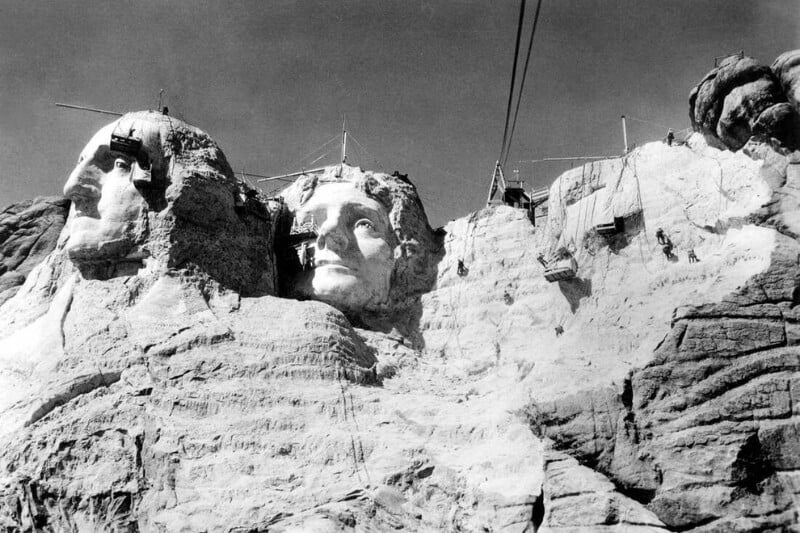
Do you ever look at something so impressive, like Mount Rushmore, and wonder how it was made? It may be hard to believe, but the four faces of this famous landmark were carved by removing about 450,000 tons of solid rock! With incredible skill and dedication, nearly 400 workers worked for 14 years to make this monument a reality. About 90% of the memorial was blasted with dynamite. The rest included drilling, chiseling, and a finishing method called “bumping.”
Symbolism Behind the Carvings on Mount Rushmore
Mount Rushmore is a huge work of sculpture, and it shows the skill of the people who carved it. The Park Service says the four faces stand for the birth, growth, development and preservation of the United States.
What Mount Rushmore Looks Out On
While human ingenuity went to the construction of Mount Rushmore, much of the nation starved. Built upon stolen land, it looks out over the people lied to through treaties not worth the paper they are written on.
The busts on Mount Rushmore face southeast, directly towards Pine Ridge Reservation. Pine Ridge, formerly known as Red Cloud Agency and deemed worthless land, is home to the Oglala Lakota. Removed from significant infrastructure, emergency agencies, jobs, and more, Pine Ridge is alive with the descendants of the genocidal work of the U.S. Army. As a result, Pine Ridge Reservation holds the unwelcome designation as the poorest area in the United States.
Mount Rushmore Today
While Mount Rushmore continues to be depicted in a way that’s comfortable for most, the truth is often intentionally ignored. The carving wasn’t created to inspire patriotism at all. It was drawn up to attract visitors, make it palatable for government funding, and as a symbol of domination over the rightful owners of the land.
Changes to the monument are needed, and we eagerly await what will come. In the meantime, Mount Rushmore brings people to the Black Hills almost 100 years later. For us, it provides the opportunity to tell a much bigger story.