On the evening of July 17, 2026, at a ceremony inside the park, Badlands National Park was certified as an International Dark Sky Park by DarkSky International. It is the first and only certified International Dark Sky Park in South Dakota, one of roughly 40 National Park Service units nationwide to hold the designation, and one of only two in the Park Service’s Midwest Region.
We have been guiding people through this park after dark for years, so a fair question is whether a certificate changes anything. The honest answer: the sky did not change on July 17. What changed is that it is now measured, documented, and formally protected, and that is worth more than it sounds.
Here is what the Badlands dark sky designation actually means.
What is an International Dark Sky Park?
The International Dark Sky Places Program has been run by DarkSky International since 2001. It certifies parks, communities, reserves, and sanctuaries that meet a specific standard for night sky quality and for responsible outdoor lighting.
It is not a scenic award and it cannot be won by having a pretty view. To certify, a park has to:
- Take and submit sky-quality measurements over an extended period
- Inventory every outdoor light fixture on the property
- Retrofit non-compliant lighting to be shielded, warm-toned, and no brighter than necessary
- Commit to ongoing night sky monitoring after certification
- Run public education and outreach about light pollution
- Report back periodically to keep the certification
In other words, it is a maintenance obligation, not a plaque.
How long the Badlands dark sky designation took
Seven years.
The effort started in 2018, pushed by members of the public and by conservation partners rather than imposed from above. Over that period, Badlands National Park and the Badlands National Park Conservancy replaced outdoor lighting across park facilities to reduce glare and skyglow, and established long-term night sky monitoring.
That is the part worth sitting with. Somebody spent seven years counting light fixtures so that the sky above a place most people drive through in ninety minutes would still be dark in fifty years.
Just how dark is the Badlands sky?
Night sky darkness is described using the Bortle scale, which runs from Class 1, the darkest sky measurable anywhere on Earth, to Class 9, an inner-city sky where you can pick out the Moon and maybe four stars.
Badlands National Park sits at approximately Bortle Class 2.
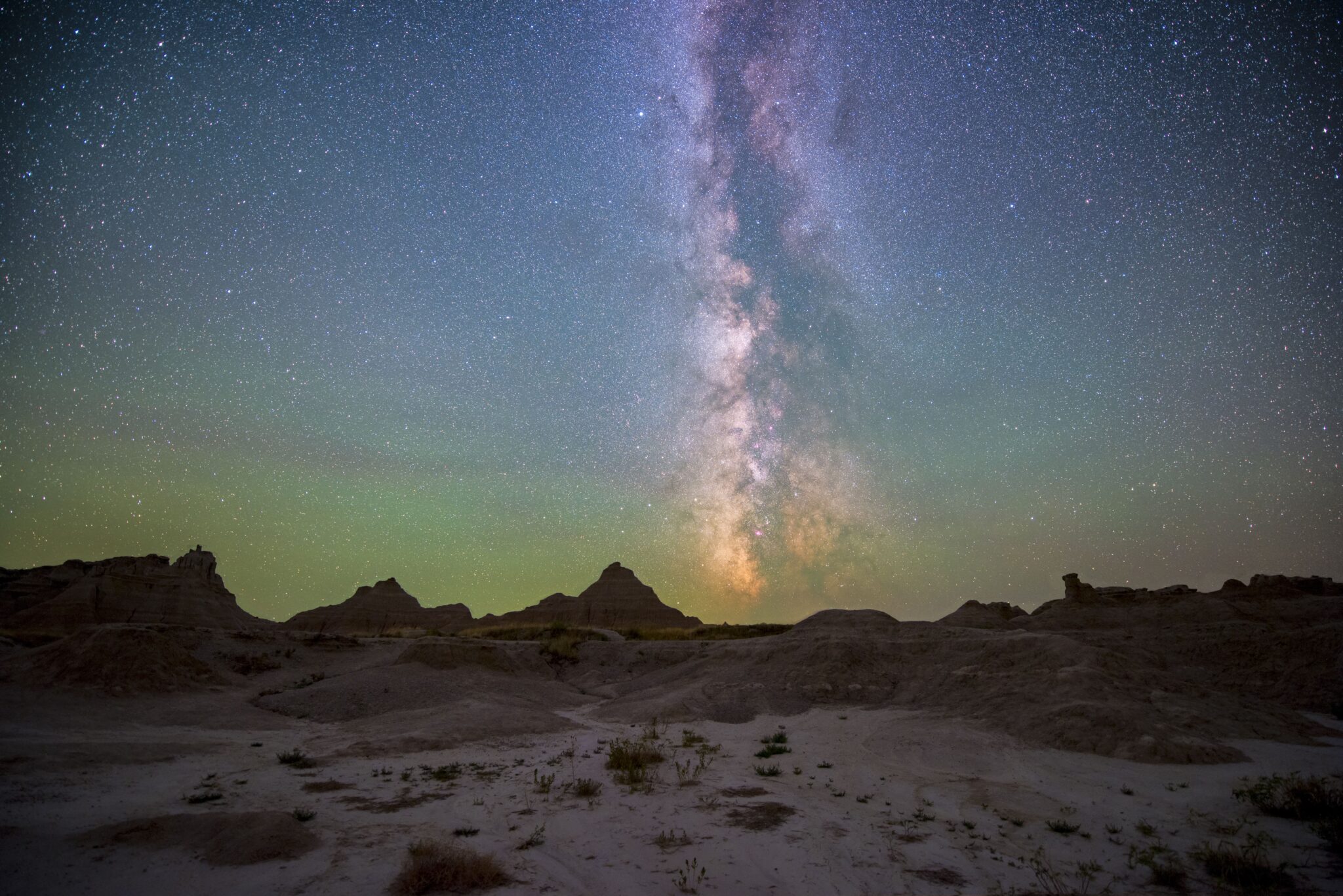
At Class 2, the Badlands National Park Conservancy reports more than 7,500 stars are visible to the naked eye on a clear night. For comparison:
- Inner city (Bortle 8 to 9) — under 50 stars
- Suburban backyard (Bortle 5 to 6) — a few hundred
- Rural, away from towns (Bortle 3 to 4) — 1,000 to 2,500
- Badlands National Park (Bortle 2) — more than 7,500
The practical difference at Class 2 is not that you see more of the same thing. It is that you start seeing different categories of thing: structure and dust lanes in the Milky Way instead of a smudge, the Andromeda Galaxy without optics, visible color differences between stars, and enough ambient starlight to walk by.
It is not only about the view
The certification protects wildlife as much as scenery. The Badlands supports nocturnal species that depend on genuine darkness, including burrowing owls, several bat species, and the endangered black-footed ferret, one of the rarest mammals in North America and a species the Badlands has been central to recovering.
Artificial light at night disrupts hunting, navigation, breeding, and migration for all of them. Protecting the sky and protecting the ferret turned out to be the same job. Our Badlands National Park wildlife guide covers the species involved in more detail.
What changes for visitors
Practically, in the short term: not much, and that is by design. The park is not adding gates or fees. There is no permit for looking up. What you should expect instead:
- More people at night. Designation drives visitation. The park was quiet after dark; it will be less quiet. Summer new-moon weekends in particular
- More programming. Expect the park and the Conservancy to expand ranger-led astronomy events and the annual astronomy festival now that the certification is formalized
- Better lighting where lighting exists. The retrofits are already done, so facility areas are easier on your night vision than they used to be
- A reason to plan around the moon rather than the calendar. This is the single biggest thing most visitors get wrong
How to actually see it
A few things we have learned running night trips out here:
Plan around the new moon, not the season. A full moon erases a Bortle 2 sky as thoroughly as a city does. The ten-day window centered on the new moon is what you want. Everything else is secondary to this.
Stay far longer than feels necessary. Full dark adaptation takes 20 to 30 minutes of uninterrupted darkness, and one look at a phone screen resets it. The people who leave after fifteen minutes genuinely do not see the same sky as the people who stay ninety.
Go west in the park. The Sage Creek Rim Road area and the Sage Creek Wilderness are the darkest and most remote sections, with the lowest horizon glow in any direction. Our guide to the best viewpoints in Badlands National Park covers the daytime versions of these spots.
Dress for a different climate than the one you drove out in. This is high prairie. A 90 degree afternoon becomes a 50 degree night with wind. See our Badlands travel tips.
Bring a tripod before you bring a better camera. For Milky Way photos, stability beats gear.
Seeing it with a guide
You do not need us to look at the sky. It is free, it is public land, and we would rather you go than not go.
What a guide changes is the parts that are easy to get wrong: which night to pick for the moon phase and forecast, where to be, staying long enough to actually dark-adapt, and having somebody who can name what you are looking at without reading an app out loud.
We run the Badlands International Dark Sky Park Tour as a private evening trip from Rapid City built entirely around this certification: golden hour into the park, sunset from a chosen overlook, then several hours parked in the dark with zero-gravity chairs, a telescope when conditions allow, and photography help for anyone who wants it.
If you would rather have sunset be the main event with a shorter evening, our Badlands Sunset and Night Sky Tour is the better fit. And if you are still building the wider trip, start with Badlands National Park and the Black Hills and Badlands at night.