

What is the story of Devils Tower National Monument?
Devils Tower National Monument rises dramatically from the rolling grasslands of northeastern Wyoming, its sheer stone columns towering 867 feet above the surrounding Belle Fourche River valley. To geologists it represents one of the most remarkable igneous formations in North America. To many Native American tribes it is Bear Lodge, a sacred place tied to ancient stories and ongoing spiritual traditions.
The story of Devils Tower is not a single narrative. It is a convergence of geology, Indigenous cultural history, early conservation efforts, and modern exploration. Understanding the monument means looking beyond its striking appearance to the deeper forces and traditions that shaped it.
The Geological Formation of Devils Tower
Devils Tower is a massive igneous intrusion formed when molten rock pushed upward through older sedimentary layers roughly 50 million years ago during the Eocene Epoch. The magma never erupted as a volcano. Instead, it cooled slowly underground.
As the magma cooled, it contracted and fractured, creating the remarkable vertical columns that define the tower today. This process, known as columnar jointing, forms polygon shaped columns, most commonly hexagonal.
Over millions of years, erosion stripped away the softer sedimentary rock that once surrounded the intrusion. What remained was the dense core of hardened magma, now exposed as the towering monolith visitors see today.
The formation stands 867 feet above the Belle Fourche River and more than 1,200 feet above its base in some areas, making it one of the most visually striking geological features in the United States.
The Tower’s Unique Columns
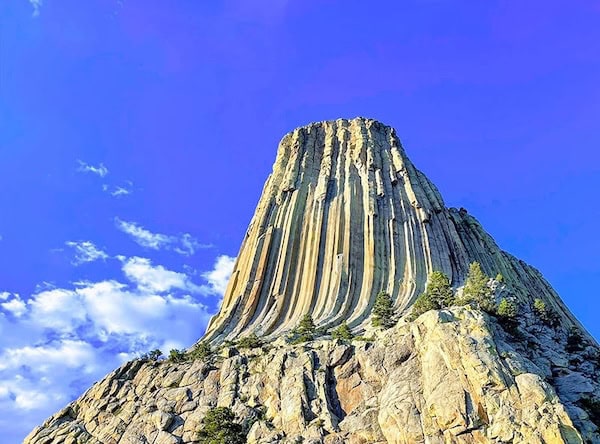
The vertical columns that wrap around Devils Tower are its most recognizable feature. These columns range from roughly six to ten feet across and can extend hundreds of feet from the base to the summit.
They formed as the molten rock cooled and shrank, cracking into long geometric columns. While columnar jointing occurs in other places around the world, the scale and uniformity at Devils Tower are exceptional.
The columns appear almost sculpted, rising in parallel ridges that give the monument its distinctive texture. From a distance, the formation resembles a bundle of massive stone pillars rising from the earth.

The Rock That Forms the Tower
Devils Tower is composed primarily of phonolite porphyry, a rare type of igneous rock formed from magma rich in alkaline minerals. Phonolite is dense and resistant to erosion, which helped preserve the tower while surrounding rocks gradually wore away.
This durability explains why the tower remains so sharply defined today. While the surrounding sedimentary formations eroded over tens of millions of years, the phonolite core remained intact.
The result is a dramatic geological landmark that reveals a deep chapter of Earth’s volcanic past.
A Geological Landscape Around the Tower
Devils Tower does not stand alone geologically. The surrounding landscape contains layers of sedimentary rock that tell a much older story of ancient environments.
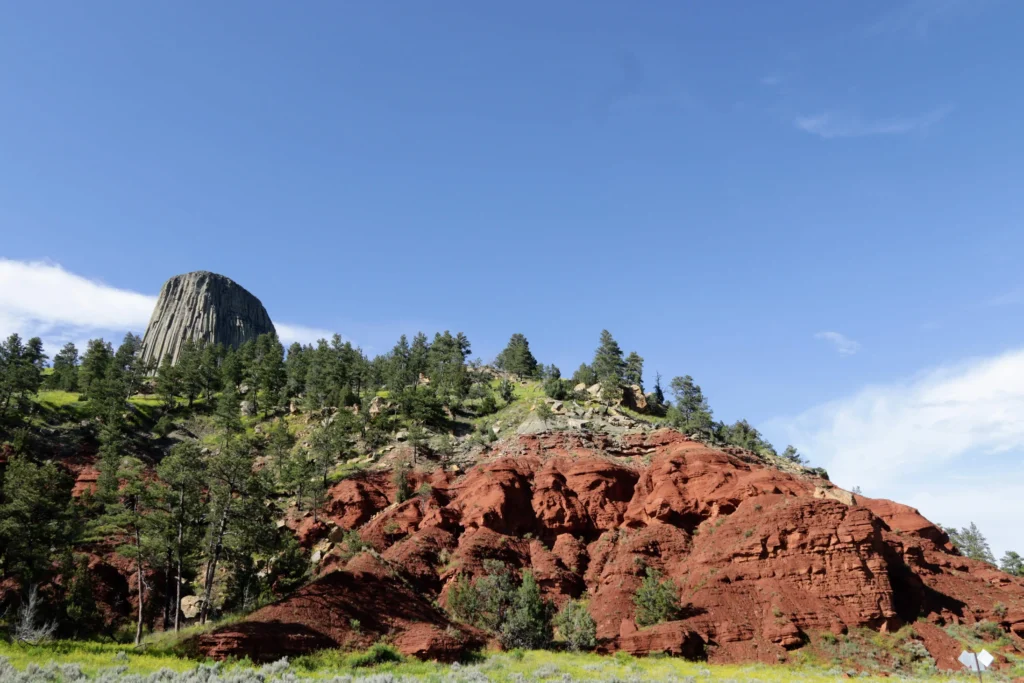
At the base of the tower, the Spearfish Formation and Red Beds reveal rock layers deposited hundreds of millions of years ago when shallow seas and coastal plains covered the region. These formations contain sandstone, shale, and mudstone colored in shades of red, gray, and green.
Nearby, the Little Missouri Buttes rise from the prairie as smaller igneous formations that share a similar geological origin. These buttes are often described as geological siblings to Devils Tower, created through the same volcanic processes that shaped the region.
Together, these formations form a natural record of the Black Hills region’s ancient past.

Sacred Meanings and Native American Traditions
Long before Devils Tower became a national monument, it was a place of deep cultural and spiritual importance to many Native American tribes. The Lakota, Cheyenne, Crow, Kiowa, and other Plains tribes maintain long standing connections to the site.
Many tribes refer to the tower as Mato Tipila, meaning Bear Lodge. Oral traditions from several tribes tell stories explaining the tower’s distinctive grooves as the claw marks of a giant bear.
In one widely shared story, a group of children were chased by a great bear. The ground beneath them rose into the sky to protect them, lifting them beyond the bear’s reach while the animal clawed at the rock below. The grooves carved into the tower became the vertical columns visible today.
These stories are part of a broader cultural tradition that recognizes Devils Tower as a sacred landscape. For many tribes, it remains a place for prayer, ceremony, and spiritual connection.
Ceremonies and Cultural Respect
Devils Tower continues to be used for ceremonies by Native American tribes today. Prayer ties can often be seen tied to trees around the monument, marking offerings and spiritual practices.
June is an especially important month for ceremonial activities. During this time many climbers voluntarily avoid ascending the tower out of respect for Indigenous traditions.
Visitors are encouraged to treat the area with respect by leaving prayer cloths undisturbed and observing posted guidelines.
Understanding this cultural significance is essential to appreciating Devils Tower beyond its geology.
The Origin of the Name “Devils Tower”
The name Devils Tower likely originated during an 1875 military expedition led by Colonel Richard Irving Dodge. During the expedition, a translation error reportedly turned an Indigenous reference to “Bad God’s Tower” or “Bear Lodge” into the name “Devils Tower.”
The name has remained official since that time, although many tribes and historians advocate for restoring a name that better reflects the monument’s Indigenous heritage.
Today the National Park Service acknowledges both the official name and the cultural names used by Native American communities.
America’s First National Monument
Devils Tower became the first national monument in the United States on September 24, 1906. President Theodore Roosevelt designated the site under the newly created Antiquities Act.
Roosevelt’s decision marked the beginning of a broader national effort to preserve significant natural and cultural landmarks across the country.
The monument protects more than 1,300 acres of prairie, forest, and geological formations surrounding the tower.
Climbing History
The first documented ascent of Devils Tower occurred in 1893 when rancher William Rogers and Willard Ripley climbed the formation using a wooden ladder system constructed from wooden stakes driven into cracks in the rock.
Remnants of this early ladder remained visible on the tower for decades.
Today Devils Tower is one of the most famous traditional climbing destinations in North America. Climbers from around the world come to attempt its challenging crack systems and long vertical routes.
The voluntary June climbing closure allows climbers to respect the tower’s cultural significance while preserving access the rest of the year.
Wildlife and the Natural Landscape
The landscape surrounding Devils Tower is a transition zone between prairie and forest ecosystems. Ponderosa pine forests cover the hills while open grasslands stretch across the valley floor.
Wildlife commonly seen in the area includes:
-
prairie dogs
-
mule deer
-
white tailed deer
-
wild turkeys
-
hawks and eagles
The tower itself hosts colonies of lichens that grow directly on the rock face, adding subtle colors of green, yellow, and orange to the stone.
Periodic wildfires also play a natural role in shaping the forest ecosystem, clearing underbrush and allowing new vegetation to grow.


Visiting Devils Tower Today
Devils Tower National Monument welcomes hundreds of thousands of visitors each year.
The most popular trail is the Tower Trail, a 1.3 mile paved loop that circles the base of the formation and offers close views of the towering columns.
Another scenic route is the Red Beds Trail, a 2.8 mile loop that passes through forests and red rock formations while providing broader views of the surrounding landscape.
Summer is the busiest season, and traffic entering the monument can sometimes be slow during peak hours. Visiting early in the morning or later in the evening often provides a quieter experience.
Why Devils Tower Is So Remarkable
Devils Tower stands at the intersection of natural forces and human stories. It is a geological formation shaped by volcanic processes deep within the Earth. It is a sacred site woven into the oral traditions of multiple Native American tribes. It is also a landmark in American conservation history as the nation’s first national monument.
Few places in North America bring together geology, cultural history, and dramatic landscape in such a powerful way.
For many visitors, the most lasting impression comes from simply standing beneath the tower’s immense stone columns and realizing the immense span of time and tradition represented in the rock.
Experience Devils Tower with My XO Adventures
Seeing Devils Tower in person is unforgettable. The tower rises suddenly from the prairie, its massive columns glowing in the changing light of the day. But understanding the deeper stories behind the monument makes the experience even more meaningful.
Our Devils Tower tours from the Black Hills are designed to bring those stories to life. Along the way you will learn about the geology that formed the tower, the cultural traditions tied to Bear Lodge, and the landscapes that surround one of America’s most remarkable landmarks.
If Devils Tower is on your list of places to experience, we would love to help you explore it with deeper context and local insight.
Join us for a Devils Tower tour and discover the stories written in stone.