

From Ancient Inland Seas to Granite Peaks and Layered Badlands.
Discover how uplift, erosion, and deep time shaped the dramatic landscapes of western South Dakota.
Black Hills and Badlands Geology is the story of how this landscape came to be. Ancient inland seas once covered western South Dakota. Deep forces beneath the Earth later lifted granite upward into what we now call the Black Hills. Wind, water, and time carved the layered formations of Badlands National Park. What looks rugged and dramatic today is the result of hundreds of millions of years of steady change.
When we guide guests through this region, one of the first things we explain is that the Black Hills and the Badlands are not separate worlds. They are chapters in the same geologic history. The granite peaks, the limestone canyons, the striped clay hills, even the fossils beneath the surface all connect back to a sequence of events that shaped this land long before people arrived.
If you have ever stood at an overlook and wondered why the Badlands look banded, how Mount Rushmore could be carved into solid rock, or why seashell fossils appear in the middle of the Great Plains, the answers are written in the layers beneath your feet. Once you understand the geology, the scenery shifts. You are no longer just looking at beautiful formations. You are reading deep time across the horizon.
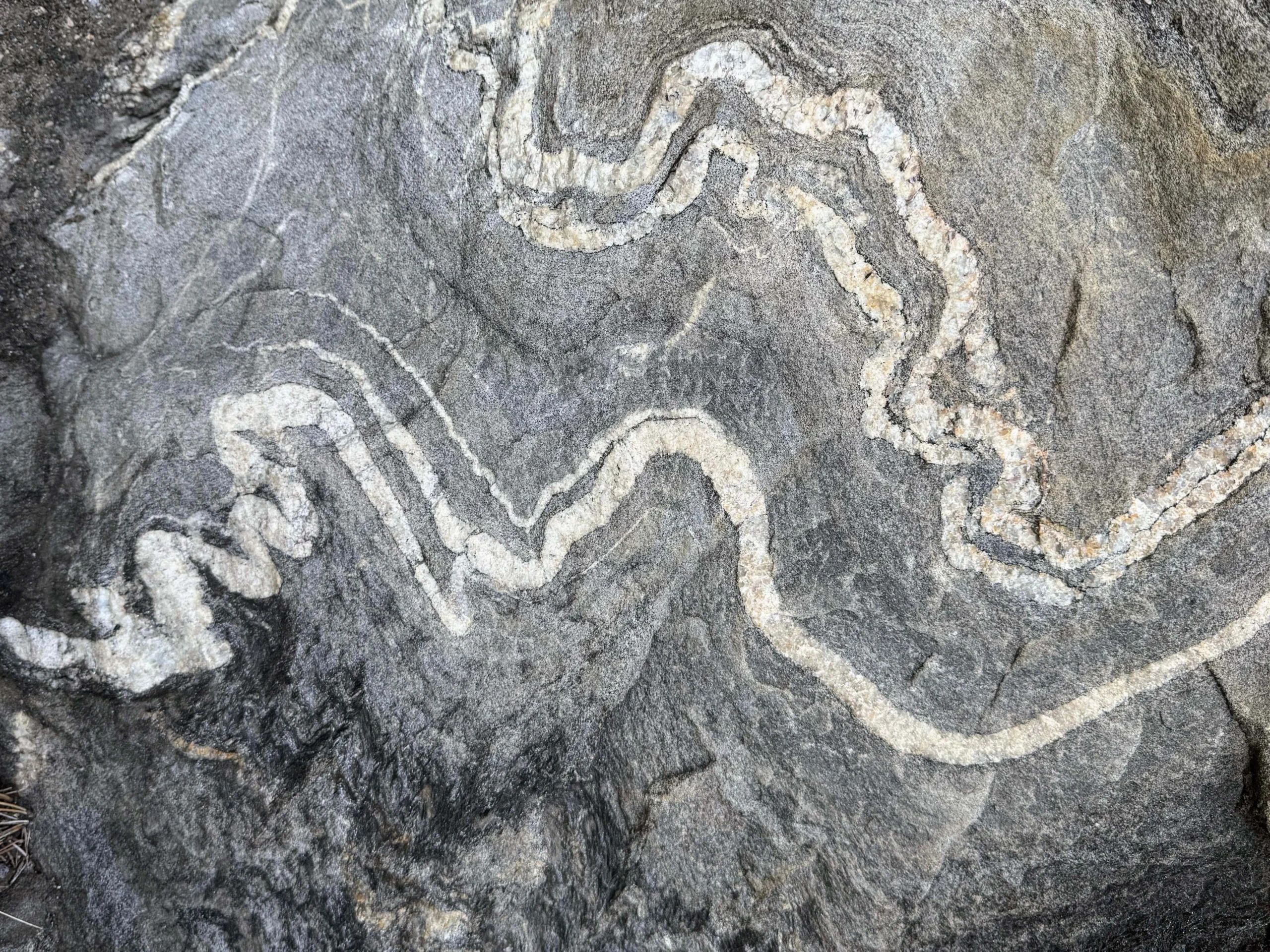
The Black Hills were formed when deep tectonic forces pushed ancient granite upward into a dome shape roughly 60 million years ago. This event, known as the Black Hills uplift, raised some of the oldest rock in North America from deep below the surface and tilted younger sedimentary layers outward around it. What appears today as forested mountains rising from the plains is actually a geological dome created by pressure from below and shaped by millions of years of erosion.
To understand the geologic history of the Black Hills, we have to go much farther back than 60 million years. The granite core of the Black Hills began forming nearly 1.8 billion years ago during the Precambrian era. At that time, molten rock cooled deep underground and hardened into crystalline granite and metamorphic rock. For over a billion years, these rocks remained buried beneath layers of younger sediment deposited by shifting seas and rivers.
Around 60 to 70 million years ago, tectonic activity associated with the Laramide orogeny caused stress throughout western North America. Instead of forming a long mountain chain, the pressure here pushed the ancient granite core upward in a dome-like structure. This is what geologists refer to as the Black Hills uplift.
Imagine pressing upward beneath a stack of layered blankets. The center rises first, and the outer layers tilt away from the middle. That is exactly what happened here. The uplift exposed the granite core of the Black Hills at the center while younger sedimentary rock layers tilted outward in concentric rings.
This dome structure explains why the Black Hills look so different from the surrounding plains. It also explains why the region contains such diverse South Dakota rock formations within a relatively small area.


Before the uplift occurred, much of this region sat beneath an ancient inland sea. Sediment accumulated in horizontal layers over millions of years. Limestone, shale, and sandstone formed as marine deposits hardened into rock.
When the uplift happened, those once-flat sedimentary layers were tilted upward around the rising granite core. Today, if you travel outward from the center of the Black Hills, you can see these tilted layers forming visible rings. Geologists sometimes refer to this pattern as the “bullseye” structure of the Hills.
Spearfish Canyon geology provides a clear example. The towering limestone walls were once horizontal seabeds. After uplift, they were elevated and later carved by water into the canyon we see today.
The granite core of the Black Hills is what makes landmarks like Mount Rushmore possible. The Mount Rushmore rock type is a durable granite that resists erosion better than surrounding sedimentary rock. Without the exposure of this ancient granite during the Black Hills uplift, the monument could not have been carved where it stands today.
Granite weathers differently than softer rock. Over time, water seeps into fractures, freezes, expands, and widens cracks. Surrounding material erodes away, leaving behind steep formations like Cathedral Spires along the Needles Highway. These dramatic granite peaks are physical evidence of deep time and long-term weathering acting on the exposed core of the uplift.
Understanding how the Black Hills were formed gives context to everything else in the region. The granite core, the tilted sedimentary layers, and the ring-like structure all trace back to the same uplift event. But the story of Black Hills and Badlands Geology does not end with rising rock. The next chapter begins with water, sediment, and an ancient sea that once covered much of South Dakota.
Long before the Black Hills uplift reshaped the region, much of western South Dakota lay beneath a vast inland sea. This shallow body of water stretched across the center of North America during the Cretaceous period, covering what is now the Great Plains. The ancient inland sea of South Dakota deposited thick layers of sediment that would later become the sedimentary rock layers in Badlands National Park and around the Black Hills.
For millions of years, fine mud, sand, and calcium-rich material settled slowly to the sea floor. Over time, these deposits hardened into shale, sandstone, and limestone. These sedimentary layers formed in horizontal sheets, stacking one atop another like pages in a book. At the time, there were no mountains here. There were no granite peaks. There was only water and accumulating sediment.
Limestone cliffs found in places like Spearfish Canyon began as marine sediment on the floor of this inland sea. Shell fragments, microscopic organisms, and calcium carbonate compacted into thick rock layers. These limestone formations are evidence that the region once supported marine ecosystems filled with ancient sea life.
If you look closely at certain sedimentary exposures in western South Dakota, you may even find marine fossils embedded within the rock. Seashell fossils in this region are not anomalies. They are proof that the landscape we now associate with pine forests and prairie was once underwater.

In deeper parts of the inland sea, fine mud settled and later hardened into shale. In shallower areas, shifting currents deposited sand that eventually became sandstone. These materials formed the base layers that would later tilt during the Black Hills uplift.
When uplift occurred, the once-flat sedimentary layers were raised and angled outward. Today, those tilted rock formations are visible in road cuts, canyon walls, and Badlands exposures. The sedimentary rock layers in Badlands National Park owe their existence to this long period of marine deposition followed by uplift and erosion.
As the inland sea retreated, rivers and floodplains replaced marine conditions. New layers of sediment accumulated over older marine deposits. Volcanic ash from distant eruptions drifted into the region, mixing with river sediments and forming distinct mineral-rich bands. These volcanic ash layers in the Badlands contribute to the varied colors seen today in Badlands National Park geology.
The transformation from sea floor to exposed rock required two major processes: uplift and erosion. Without the Black Hills uplift, these sedimentary layers would have remained buried. Without erosion, they would not be visible at the surface.
The ancient inland sea of South Dakota laid the foundation for much of the region’s geology. It created the sedimentary layers that now record marine life, river systems, and volcanic events. When uplift exposed these layers and erosion began sculpting them, the stage was set for one of the most dramatic landscapes in North America. That landscape is the Badlands.
The Badlands were formed when thick layers of sediment were deposited across western South Dakota and then slowly carved by erosion into ridges, buttes, gullies, and sharp spires. This landscape began as river and floodplain deposits laid down after the ancient inland sea retreated. Over time, Badlands volcanic ash layers mixed into these sediments, adding minerals that influence both color and texture in Badlands National Park geology.
The key idea is simple and readable. The Badlands did not rise up like a mountain range. Instead, the land was built from layered deposits and then sculpted by water, wind, and freeze-thaw cycles. The formations you see today are the result of material being removed, not material being piled upward.
After marine conditions ended, the region shifted into broad floodplains fed by ancient rivers. Mud, sand, and silt spread across the landscape in repeated cycles. Each new flood event laid down another layer. Over millions of years, these layers compressed into claystone, siltstone, and sandstone. Those are the sedimentary rock layers in Badlands National Park that now appear as bands across hillsides and canyon walls.
This is one reason Badlands National Park geology feels so complex when you are standing at an overlook. The rock layers are not just sediment. They are a mixture of river deposits, floodplain mud, and airborne volcanic material, all stacked and preserved through time.
The dramatic landforms of the Badlands exist because the material is soft enough to erode quickly. Rainwater cuts into exposed slopes, creating channels that grow deeper with each storm. When temperatures drop, water freezes in cracks and expands, breaking rock apart. Wind removes loose sediment and reshapes ridge lines.
This Badlands erosion process is ongoing today. That is why you can visit the same area years apart and notice subtle changes. The landscape is still being carved, inch by inch, into new shapes.
Now that you know how the Badlands were formed, the next step is learning how that erosion actually works on the ground. Once you understand the Badlands erosion process, the landscape becomes easier to read, and the patterns you see from overlooks start to make sense..
The Badlands erosion process is the primary force shaping the landscape you see today. While ancient seas and floodplains built the layers, erosion carved them into the dramatic formations that define Badlands National Park geology. Water, temperature swings, gravity, and wind continue to sculpt the land every year.
Unlike granite in the Black Hills, much of the Badlands is composed of softer sedimentary rock. Claystone, siltstone, and volcanic ash layers break down more easily under environmental stress. This difference in material explains why the Badlands appear jagged and sharply defined while the granite core of the Black Hills remains more solid and vertical.
Rainfall is the most powerful driver of erosion in the Badlands. When storms move across western South Dakota, water runs quickly over exposed slopes instead of soaking deeply into the ground. That surface runoff cuts narrow channels into the soft sedimentary rock layers in Badlands National Park.
Each heavy rain deepens gullies and sharpens ridgelines. Over time, small channels grow into larger drainage systems. This is how broad slopes become steep-walled formations.
When you stand at an overlook and see parallel ridges stretching across the landscape, you are looking at patterns created by repeated water flow over thousands of years.
Winter adds another layer to the Badlands erosion process. Water seeps into cracks and pores within the rock. When temperatures drop, that water freezes and expands. Expansion widens fractures in the sedimentary layers. When the ice melts, loosened material breaks free and falls downslope.
This freeze-thaw action is one reason the Badlands change steadily over time. It also explains why certain slopes appear crumbly or unstable underfoot.
Wind removes fine particles from exposed surfaces, especially during dry periods. Gravity pulls loosened sediment downward, reshaping slopes gradually. These forces work together with water and temperature shifts, accelerating erosion in some areas while leaving more resistant layers temporarily intact.
The contrast between soft and slightly harder layers creates the ridges and spires that give the Badlands their distinct appearance.
When we guide guests through Badlands National Park, one of the most surprising realizations for many visitors is that this landscape is still evolving. It is not a relic frozen in time. It is an active system. The ridges you photograph today will look slightly different decades from now. Understanding that ongoing erosion deepens appreciation for how dynamic Black Hills and Badlands Geology truly is.
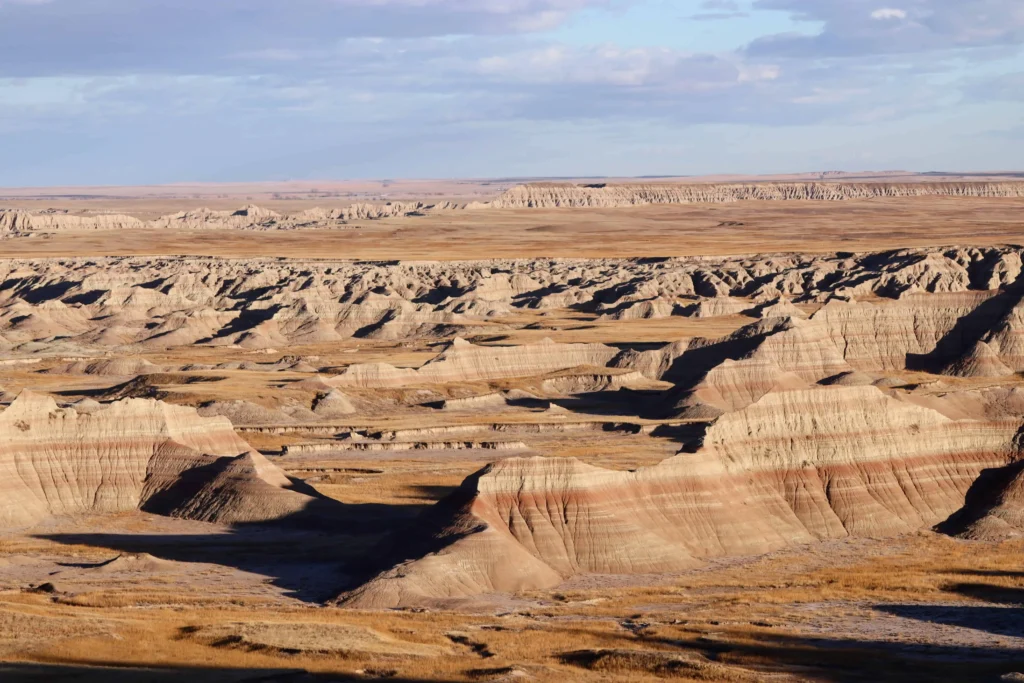
Black Hills and Badlands Geology becomes especially visible in the sedimentary rock layers in Badlands National Park, where color bands record millions of years of environmental change. Each band of color represents a different period of deposition, shaped by shifting rivers, floodplains, climate patterns, and even distant volcanic eruptions. When you look across the Badlands and see stripes of tan, red, gray, and pale yellow, you are looking at a layered archive of time.
These layers were originally laid down in horizontal sheets. Over time, they hardened into claystone, siltstone, sandstone, and ash-rich deposits. After uplift exposed them, erosion sculpted them into the ridges and buttes we recognize today. The result is a landscape where geological history is literally written across the hillsides.
You do not need a geology degree to read the landscape. Start by identifying the horizontal bands. Notice which layers appear thicker and which are thin. Look for subtle color shifts. Observe where slopes are smooth versus sharply ridged.
Thicker, more resistant layers often form ledges or flat-topped ridges. Softer layers form rounded or crumbling slopes. In some areas, you may even spot fossil-bearing layers embedded within the sediment.
This ability to interpret the rock layers transforms a visit into something deeper. Instead of simply photographing formations, you begin to understand how South Dakota rock formations developed through cycles of deposition and erosion.
Although the Badlands look very different from the granite core of the Black Hills, they are part of the same regional geological system. The Black Hills uplift exposed and tilted surrounding sedimentary rock layers. Erosion then removed material and carried it into nearby basins, where new layers accumulated.
Over millions of years, that interplay between uplift and erosion shaped both landscapes. The granite peaks of the Black Hills and the layered formations of the Badlands are different expressions of the same long geological story.
Within these sedimentary rock layers lies one of the most remarkable aspects of Badlands National Park geology. Preserved inside certain bands are fossils from a time when this region supported ancient mammals, subtropical vegetation, and entirely different ecosystems. The next chapter of Black Hills and Badlands Geology is written not just in rock, but in bone.

Black Hills and Badlands Geology also preserves evidence of ancient life, particularly in the fossil bearing layers of Badlands National Park. Preserved within the sedimentary rock layers are the remains of animals that lived here roughly 34 to 23 million years ago during the Oligocene epoch. These fossils provide a detailed record of ancient ecosystems that once covered western South Dakota.
When most visitors think about fossils, they imagine dinosaurs. The Badlands tell a different story. By the time these fossil-rich layers formed, dinosaurs were long gone. Instead, this region supported early mammals in a warm, subtropical environment filled with river systems and vegetation very different from today’s prairie.
The fossil beds of the Badlands contain:
Early horses about the size of small dogs
Rhinoceros-like mammals
Saber-toothed predators
Small camels
Tortoises
Rodent species
Ancient plants
These animals lived on broad floodplains fed by rivers that deposited sediment year after year. When animals died, some were quickly buried by new sediment layers. Over time, pressure and mineralization preserved their bones within the rock.
This is why fossils in Badlands National Park are often found in specific sedimentary rock layers that correspond to ancient floodplain deposits.
Several factors make this region ideal for fossil preservation:
First, rapid burial. Flood events covered remains quickly, protecting them from scavengers and decay.
Second, fine-grained sediment. Clay and silt help preserve delicate structures.
Third, ongoing erosion. The same Badlands erosion process that sculpts the landscape also gradually exposes fossils at the surface, allowing scientists to discover them.
Without erosion, many fossils would remain buried and unknown. Without the ancient inland sea and later floodplain deposition, the sedimentary rock layers in Badlands National Park would not exist to preserve them in the first place.
Fossils add an entirely different dimension to Black Hills and Badlands Geology. They connect rock layers to living ecosystems. They show how climate, environment, and life changed over millions of years.
When you stand in the Badlands today, you are standing in a place that once supported subtropical forests and early mammals. That realization shifts perspective. The striped hills are not just layers of sediment. They are time capsules containing evidence of worlds that no longer exist.
When we guide guests through this region, fossils often spark the deepest curiosity. Visitors are surprised to learn that this quiet landscape once supported rhinoceros-like mammals and early horses. Understanding that connection between ancient life and visible rock layers makes the geology feel more personal and immediate.

Mount Rushmore is carved into Harney Peak granite, part of the granite core of the Black Hills that was exposed during the Black Hills uplift. This rock formed nearly 1.8 billion years ago deep beneath the Earth’s surface. Its durability and structure made it suitable for large-scale carving, which is one reason the monument stands where it does today.
Understanding the Mount Rushmore rock type helps explain more than just the monument. It reveals how the geologic history of the Black Hills made certain landmarks possible in the first place.
The granite core of the Black Hills represents some of the oldest exposed rock in North America. These crystalline rocks formed during the Precambrian era when molten material cooled slowly underground. Over immense spans of time, younger sedimentary layers accumulated above them.
When the Black Hills uplift occurred, tectonic pressure pushed this ancient granite upward. Erosion then stripped away much of the overlying sediment, exposing the granite core at the center of the Hills. Today, areas around Mount Rushmore, Cathedral Spires, and parts of the Needles Highway reveal this exposed crystalline foundation.
Granite is composed primarily of quartz, feldspar, and mica. Its interlocking mineral structure makes it strong and resistant to erosion compared to surrounding sedimentary rock.
Granite’s durability is what allowed sculptors to carve Mount Rushmore with confidence that it would endure. Softer rock such as shale or claystone would have eroded too quickly. The Mount Rushmore rock type resists weathering better than most surrounding formations, allowing fine details to remain visible decades after carving.
Even so, granite is not immune to change. Water seeps into fractures. Freeze and thaw cycles widen cracks. Over long periods, weathering continues to reshape the exposed surface. The monument stands not because the rock is permanent, but because it erodes slowly.
The granite core of the Black Hills is not limited to Mount Rushmore. Cathedral Spires and formations along the Needles Highway are striking examples of granite shaped by long-term weathering. Vertical cracks, known as joints, formed as the granite cooled and later expanded when overlying rock was removed.
Water exploited those fractures. Freeze-thaw cycles widened them. Surrounding material eroded away. What remains are tall, narrow spires that define the skyline in parts of the central Black Hills.
These formations are another chapter in Black Hills and Badlands Geology, demonstrating how uplift exposed ancient rock and how erosion continues refining it.
While granite dominates the center of the Black Hills, limestone and other sedimentary rocks tell equally important parts of the story. One of the best places to see those layers clearly is Spearfish Canyon, where vertical walls reveal ancient marine deposits shaped by uplift and water.

Spearfish Canyon geology offers one of the clearest surface examples of Black Hills and Badlands Geology in action. Here, towering limestone walls rise above the canyon floor, exposing sedimentary rock layers that were once part of an ancient inland sea. These vertical cliffs offer one of the clearest windows into the marine chapter of Black Hills and Badlands Geology.
Unlike the crystalline granite core of the Black Hills, the rock in Spearfish Canyon began as sediment deposited in shallow marine environments hundreds of millions of years ago. Over time, those sediments hardened into thick limestone formations.
The limestone cliffs of Spearfish Canyon formed from calcium-rich deposits on the sea floor. Tiny marine organisms, shell fragments, and mineral sediments compacted into solid rock. These layers accumulated in horizontal sheets long before the Black Hills uplift occurred.
When tectonic forces pushed the region upward, those once-flat sedimentary layers were lifted and tilted. Later, flowing water carved downward through the uplifted rock, creating the canyon itself. Today, visitors can see stacked limestone layers rising high above the creek, each one representing a former sea floor.
This is one of the most accessible examples of how the ancient inland sea of South Dakota shaped the region’s rock record.
Spearfish Creek gradually cut through the uplifted sedimentary rock, deepening and widening the canyon over time. Water exploits natural fractures and weaknesses in limestone. Freeze-thaw cycles expand cracks. Gravity pulls loosened rock downward.
The result is a canyon that feels both rugged and structured. Unlike the softer clay formations in the Badlands, limestone forms more vertical walls and defined ledges. This contrast highlights how different South Dakota rock formations respond differently to erosion.
When driving or walking through Spearfish Canyon, look for the horizontal bands within the cliff faces. Notice how some layers protrude slightly while others recede. Those differences reflect variations in hardness and composition.
You are not just looking at a canyon. You are looking at preserved sedimentary rock layers that connect directly back to the ancient inland sea and the broader geologic history of the Black Hills.
Understanding Spearfish Canyon geology helps visitors see the relationship between marine deposition, tectonic uplift, and erosion in a single landscape.
By now, the sequence becomes clear. Ancient seas deposited sediment. Uplift exposed older rock and tilted layers. Erosion sculpted both granite and sedimentary formations into the landscapes we see today. The final step is learning how to recognize these patterns in real time while exploring the region.
Black Hills and Badlands Geology is not only visible in granite peaks and striped Badlands formations. It continues underground in the limestone caves formed within the uplifted sedimentary rock layers of the Black Hills.
Most of the region’s well known caves developed in thick limestone deposits that were originally laid down beneath the ancient inland sea of South Dakota. Long before the Black Hills uplift exposed the granite core of the Black Hills, these marine sediments hardened into limestone. When tectonic forces lifted the dome, groundwater began moving through fractures and bedding planes in the rock. Over time, slightly acidic water dissolved the limestone, slowly carving passages, chambers, and underground networks.
This process, known as dissolution, explains why many Black Hills caves feel smooth and sculpted. In other areas, ceilings collapsed or fractured later, creating jagged formations. Both styles are part of the same geologic history of the Black Hills, shaped by uplift, water movement, and time.
If you’re planning to add a cave stop to your trip, I put together a practical guide to the best options, what each cave experience feels like, and how to choose the right one for your group. You can use the Black Hills cave tours guide to compare tours, timing, accessibility, and what you’ll actually see once you’re underground.
Understanding Black Hills and Badlands Geology is not about memorizing dates or rock names. It is about learning to recognize patterns in the land. Once you understand the sequence of ancient seas, uplift, and erosion, you can begin to read the landscape in front of you.
When we guide guests through western South Dakota, we often pause at overlooks and ask a simple question: What do you notice first?
Color? Texture? Layering? Sharp ridges? Rounded hills?
Each of those observations connects directly to geological processes.
In the central Black Hills, pay attention to the character of the rock. Granite tends to form rounded domes, vertical spires, and exposed crystalline surfaces. You may see visible mineral grains in the rock face. These formations are part of the granite core of the Black Hills that rose during the Black Hills uplift.
As you travel outward from the center of the Hills, watch for changes in rock type. Limestone cliffs, red shale valleys, and sandstone ridges reflect the tilted sedimentary layers surrounding the uplifted dome. The transition is gradual, but it tells a clear story once you know what to look for.
In Badlands National Park geology, layering is the key. Notice the horizontal bands across slopes. Identify differences in color between layers. Observe where erosion has carved narrow ridges and where slopes appear smoother.
When you see striped hills stretching across the horizon, you are looking at sedimentary rock layers in Badlands National Park that formed from floodplains, river systems, and volcanic ash layers in the Badlands. The sharp edges and dramatic forms are the result of the ongoing Badlands erosion process.
Standing at an overlook, you can often trace drainage patterns where water has carved parallel channels into the hillsides. Those repeating ridges are evidence of thousands of years of rainfall reshaping soft sediment.
The greatest shift happens when visitors realize they are not just looking at beautiful formations. They are looking at time made visible.
The granite core of the Black Hills represents rock nearly 1.8 billion years old. The fossil-bearing layers in the Badlands capture ecosystems from roughly 30 million years ago. The erosion happening today continues altering the land in real time.
Black Hills and Badlands Geology connects these moments into one continuous story. When you understand that sequence, the landscape feels larger, older, and more dynamic than it first appears.
As guides, our responsibility is not only to explain how the land formed, but to help visitors feel the scale of that history. When someone begins to see uplift in a granite dome or recognize sedimentary layers stretching across a Badlands ridge, something shifts. The land becomes less mysterious and more meaningful. Awe deepens because it is grounded in understanding.

You don’t have to be a geologist to recognize the forces that shaped the Black Hills and Badlands. Some places make the story easy to read just by standing still and looking around. In the Black Hills, granite peaks like the Cathedral Spires reveal the uplifted core of the region. The surrounding limestone cliffs show younger layers that tilted outward as the dome rose. Each overlook or trail offers a different window into how time, pressure, and erosion worked together.
The Badlands tell their story in color. Soft clay and ash layers form steep slopes that expose millions of years of ancient environments. Places like Pinnacles Overlook, Big Badlands Overlook, and the Notch Trail offer clear views of sediment bands shaped by floods, droughts, and long-vanished wildlife. When you visit these areas after reviewing the Unique Landforms, Ecology, or Weather pages, the landscape feels alive with meaning. Once you learn what the layers represent, every ridgeline becomes part of a timeline stretching back into deep time.
Black Hills and Badlands Geology tells a unified story of uplift, inland seas, sedimentary rock layers, erosion, and fossil preservation. These quick facts highlight the key processes that shaped western South Dakota.
• The Black Hills were formed through a dome uplift known as the Black Hills uplift. The granite core of the Black Hills contains some of the oldest exposed rocks in North America, surrounded by younger sedimentary layers that tilt outward like rings in a tree.
• The Badlands erosion process makes this one of the fastest changing landscapes in the country. Wind, rainfall, and freeze-thaw cycles continually carve into soft sedimentary rock layers in Badlands National Park.
• An ancient inland sea once covered South Dakota. Many sediment layers in the Badlands formed from marine minerals, shells, and mud deposited in warm, shallow water environments.
• Volcanic ash layers in the Badlands came from distant eruptions. Over time, these ash deposits hardened into soft rock that erodes into the pale and colorful bands seen in Badlands National Park geology.
• Fossils in Badlands National Park preserve ancient mammals, marine organisms, and prehistoric plant life. These fossil-bearing layers help scientists understand the geologic history of the Black Hills and surrounding plains.
Black Hills and Badlands Geology connects directly to related topics like Unique Landforms, Wildlife, and Ecology, where geology shapes soil, water flow, plant communities, and habitat patterns across the region.
For visitors planning a deeper exploration, the directory on Parks, Monuments, and Protected Land of the Black Hills and Badlands provides helpful context for understanding how geology influences today’s protected landscapes.
Black Hills and Badlands Geology includes terms that describe uplift, sedimentation, erosion, and fossil preservation. Understanding these definitions makes the landscape easier to read.
Rock layers formed when minerals, mud, and organic material settle over time and harden. These layers hold clues about the environments that created them.
The process of wind, water, and ice wearing away rock and soil. Erosion is what shapes the cliffs, ridges, and gullies of the Badlands.
A geological force that pushes rock layers upward from below the Earth’s surface. The Black Hills were formed through this slow dome-shaped uplift.
Fine material from distant volcanic eruptions that settled across the Great Plains millions of years ago. These layers help form the colorful bands in the Badlands.
Places where preserved remains or impressions of ancient plants and animals are found. The Badlands contain some of the most significant fossil beds in North America.
Hard, ancient rock formed deep within the Earth from cooled molten material. Granite and similar rocks make up the core of the Black Hills.
The immense span of time used to describe Earth’s history. It helps explain slow processes like uplift, erosion, and sediment formation.
Particles of rock, mineral, or organic matter carried by wind or water and deposited in layers that eventually become rock.

If you’d like to keep building your understanding of the region, the Visitor Learning Center offers guides that connect directly to the geology you’ve learned here. Each topic adds a new layer of insight, helping you see how the land, wildlife, weather, and human story all tie back to the forces that shaped the Black Hills and Badlands.
You can explore Ecology, Unique Landforms, Wildlife, Weather, Indigenous History and Cultural Perspectives, Sacred Sites, Travel Tips, and Safety and Preparation to understand how geology influences everything from plant communities to seasonal changes. These guides help you step into the landscape with more clarity, curiosity, and confidence.
If you’d like to explore the Black Hills and Badlands Geology even further, these trusted resources offer clear, science-based explanations that build on what you’ve learned here. They provide maps, diagrams, fossil information, rock layer descriptions, and current research that help bring the region’s deep history into focus.
These links connect you with the agencies and organizations that study and protect the land every day. They complement the Visitor Learning Center and help you understand the forces that shaped the landscapes you’ll explore.
Recommended Geology Resources:
Below are common questions visitors ask about Black Hills and Badlands Geology and how the region was formed.
The Black Hills were uplifted during a mountain-building event called the Laramide Orogeny. Deep, ancient granite rose upward while surrounding sedimentary layers tilted and folded around it, creating the dome-shaped structure we see today.
Millions of years ago, a shallow inland sea covered much of this region. Marine life lived and died here, leaving behind fossil evidence that is now embedded in sedimentary rock layers.
Soft sedimentary rock erodes quickly under wind, rain, and freeze-thaw cycles. Because different layers erode at different rates, the result is jagged ridges, spires, and deeply etched gullies.
Uplift from the Black Hills pushed surrounding sediment upward. Over time, erosion stripped away surface material, exposing tilted layers like pages in a book.
Boxwork is a honeycomb-like mineral formation found in Wind Cave. It forms when calcite fills cracks in limestone and the surrounding rock later erodes away. It’s rare because the specific chemical conditions required are uncommon.
Major mountain-building activity has long ended, but erosion continues constantly. The landscape you see today is still slowly changing through weather and natural processes.
Granite weathers differently than layered sediment. It tends to round and fracture into domes and massive blocks, while sedimentary rock breaks into ridges and bands.
Notice color changes, layer thickness, rock texture, and slope angles. When you slow down and observe patterns instead of just scenery, the geology becomes easier to interpret.
Explore the region with My XO Adventures and see these geological stories unfold in the landscapes around you.
This page was written by Daniel Milks, owner and guide at My XO Adventures. Years of exploring the Black Hills and Badlands have shaped his understanding of the region’s geology, from the quiet power of granite peaks to the delicate layers of the Badlands. He shares these stories not as a scientist, but as someone who spends time on the land every day and sees how the forces of uplift, erosion, and deep time shape the places visitors love most.
Daniel’s approach to guiding blends curiosity, connection, and respect for the land’s long history. His experiences in the field help visitors see landscapes not just as beautiful scenes, but as chapters in a much older story. You can learn more about his background, philosophy, and approach to guiding on the Author Page, created to offer a deeper look at the person behind My XO Adventures.