


The Ghost Town of Spokane South Dakota
It’s my last day of the year to visit Custer State Park. I’m on my own and decided to take Iron Mountain Road to pay a visit to the old ghost town of Spokane, in the Black Hills of South Dakota. I came here after reading The Spokane Kid, a story about a boy becoming a man as he learns the ways of the Black Hills. Living in Keystone, he initially helped out at several campgrounds before becoming a Black Hills guide.
It’s a story I can relate to. There’s so much to learn here, and so much to respect. His Black Hills Adventures take him and his father around the entire mountain range. It took them days, running across old-timer miners and camping along the shores of Center Lake and Sylvan Lake, and throughout what is now Custer State Park.
At this time, there were quite a few small towns around Custer, which no longer exist because of the park’s formation. These lands were purchased, added to the park, and flattened to let nature take over. The story speaks of the town of Spokane, which, like most mountain towns, was mined for gold, but they soon found the area was much richer in silver, mica, and zinc.
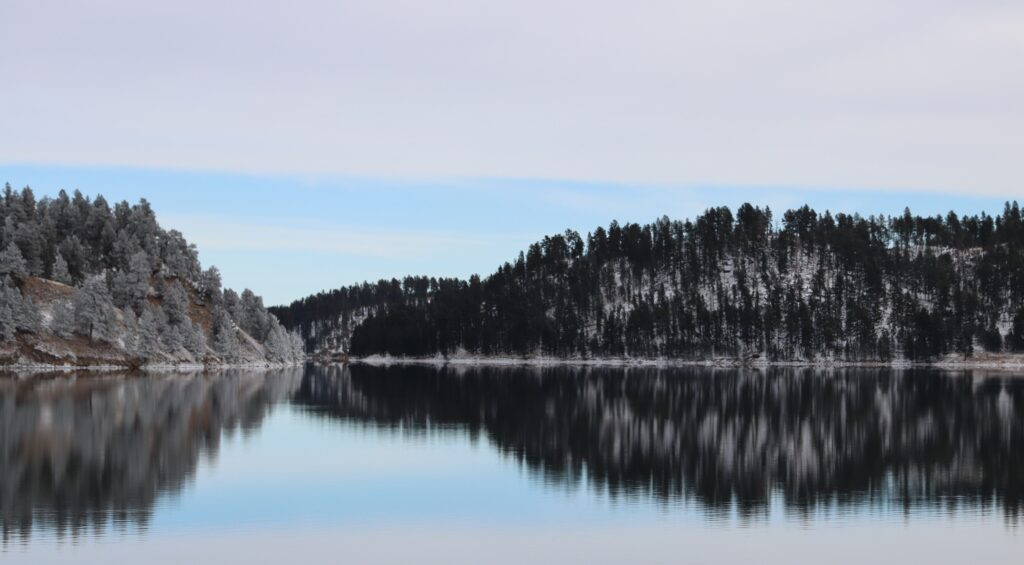
I pulled over to Spokane Creek Campground, parked the car, and followed the little sign that said “Ghost Town” on it. The forest was still gold and brown, with the Ponderosa Pine bursting with green needles. Spokane Creek ran along the trail, making it a little wet and muddy, but I was on a mission.
Soon, I begin to find evidence of miners at work. Primarily consisting of rusted sheets of metal, cans, bottles, and the like. The best park along the way is Tailings. Tailings are small to medium-sized rocks removed from the ground and piled nearby. I can see quartz, mica, feldspar, and granite. The ground appears to be littered with the jewels of the Black Hills.
Still searching for the old town of Spokane, I wandered on, not seeing a trace of buildings until I came across a cut in the forest where electrical lines run. Here, I know the foundation of a building. Whenever you’re in the Black Hills, it’s essential to stop, look, and listen. I imagine what it was like in 1893, when the story was written.
As I look around, I see significant gaps between the older trees with younger growth in between. These are the trails and roads that used to exist, and a road leads to more buildings. I follow it and come across a home with an outbuilding, classic cars, and all kinds of mining artifacts. There are mining depressions in the ground dotted everywhere. Storage tanks are built into the ground, holding who knows what.
I’m in the past, walking through areas that were first occupied by indigenous people and, more recently, by settlers from the east. It’s wonderful. I feel a sadness come over me as I realize my time here is coming to a close, albeit temporarily.
Facts about Spokane, South Dakota:
- Spokane Ghost Town was founded in 1890
- A vein of quartz is what piqued the miners’ interest
- Less gold was found than mica, silver, and graphite.
- Several significant structures still stand on the site
- The hike to Spokane, South Dakota, is moderate.
- Parking is available at the Spokane Creek Campground.
- You can also park off of Forest Service Road 330
- Spokane’s coordinates are N43.840657, W103.376041
This makes for a great trail hike before entering the Eastern Side of Custer State Park. Pick up the book “Spokane Kid” at the Iron Mountain Road gift shop at Spokane Creek Campground. Maybe soon, I’ll be leading hikes through the hills and telling tall tales of the Black Hills National Forest.
Visitors have been coming to this area as tourists for a variety of reasons since the late 1800s. It wasn’t all about mining back then, just mostly. Here’s a map of Custer State Park. The roads through the park, such as the Wildlife Loop Road, Needles Highway, and Iron Mountain Road, can get you turned around, so I suggest hiring a guide for a Black Hills Tour. I hope to see you starting in April of 2022 for another season in the Sacred Black Hills of South Dakota!